<?xml version="1.0" encoding="UTF-8"?>
<rss version="2.0"
	xmlns:content="http://purl.org/rss/1.0/modules/content/"
	xmlns:wfw="http://wellformedweb.org/CommentAPI/"
	xmlns:dc="http://purl.org/dc/elements/1.1/"
	xmlns:atom="http://www.w3.org/2005/Atom"
	xmlns:sy="http://purl.org/rss/1.0/modules/syndication/"
	xmlns:slash="http://purl.org/rss/1.0/modules/slash/"
	>

<channel>
	<title>Wild Whales</title>
	<atom:link href="http://wildwhales.org/feed/" rel="self" type="application/rss+xml" />
	<link>http://wildwhales.org</link>
	<description>Wild Whales</description>
	<lastBuildDate>Wed, 08 May 2013 17:42:32 +0000</lastBuildDate>
	<language>en-US</language>
	<sy:updatePeriod>hourly</sy:updatePeriod>
	<sy:updateFrequency>1</sy:updateFrequency>
	<generator>http://wordpress.org/?v=3.5.1</generator>
		<item>
		<title>Dall&#8217;s porpoises display rare strategy</title>
		<link>http://wildwhales.org/2013/05/dalls-porpoises-display-rare-strategy/</link>
		<comments>http://wildwhales.org/2013/05/dalls-porpoises-display-rare-strategy/#comments</comments>
		<pubDate>Tue, 07 May 2013 22:39:29 +0000</pubDate>
		<dc:creator>caitlin</dc:creator>
				<category><![CDATA[Research]]></category>

		<guid isPermaLink="false">http://wildwhales.org/?p=2710</guid>
		<description><![CDATA[Learn more about a rare reproductive strategy demonstrated by a local species of cetacean. The behavior, called mate guarding, is often observed in terrestrial species, it is considered uncommon amongst cetaceans. However, researchers have observed mate guarding in Dall’s porpoises, shedding light on a species of which little is known about its mating behavior. <a href="<?p=2710 >Read More...</a>]]></description>
				<content:encoded><![CDATA[<p>As summer nears, scientists along British Columbia’s coast are dusting off their research equipment in anticipation of the upcoming field season. In B.C. research teams head out into their study areas to take advantage of friendlier weather and longer days. Sometimes the result of field work can be unexpected discoveries.  One such research team published a study a few years ago about a rare reproductive strategy called mate guarding. While this behavior is often observed in terrestrial species, it is considered uncommon amongst cetaceans (dolphins, whales, and porpoises). In the study, researchers observed mate guarding in <a title="Dall’s Porpoise (Phocoenoides dalli)" href="http://wildwhales.org/dalls-porpoise/">Dall’s porpoises</a>, shedding light on a species of which little is known about its mating behavior.</p>
<p><strong>Risky behavior has pros and cons</strong></p>
<p>Competition for mates is one of the most widespread phenomena on the planet, and males from many species have developed incredible techniques to secure their paternity. From the impeccably decorated nests of the male Bower bird to the time many human males spend at the gym, it’s safe to say men dedicate a lot of time prepping and searching for their perfect mate. So what happens when they find one? Well, it depends on the species.</p>
<p>For some species, males may try to hold onto their partner by mate guarding.  Such behavior occurs when the male monitors his mate’s movements in close proximity, and challenges any potential rivals. While this behavior can increase the chance that a specific male will successfully mate with the female he guards, it has its downsides as well.  Mate guarding requires the male to closely attend to his mate, reducing the amount of time the male may otherwise spend feeding. Aggressive interactions between males can also result from mate guarding, as many males may battle over a single female.  Regardless of the consequences, recent research has indicated mate guarding may be an important part of the mysterious reproductive strategies of Dall’s porpoises.</p>
<p><strong>Defensive Dall’s</strong></p>
<p><i>Th<a title="Mate Guarding" href="http://http://www.sfu.ca/biology/faculty/dill/publications/WillisDill2007.pdf" target="_blank">e study, published by Pamela M. Willis and Lawrence M. Dill in the journal Ethology</a></i>, is among the first to observe mate guarding in Dall’s porpoises. After obtaining data on 87 pairs of Dall’s porpoises, they concluded males were more likely to surface in synchrony with a female counterpart, and maintain closer and longer associations with females versus males. Additionally, males paired with females were observed aggressively interacting with other adult males, suggesting the males were defending their mates against rivals. Although these observations provide major insight into the mating habits of Dall’s porpoises, the authors of the study agree more research into the reproductive strategies of these cetaceans will allow for a broader understanding of their mysterious underwater lives.</p>
<p><strong>Not uncommon along our coast</strong></p>
<p>If you’re out on the water, keep your eyes out for Dall’s porpoises; they can be found along our coast year round. At this time of year you may be lucky enough to observe some of the robust males guarding their slightly smaller mates. By contributing your sightings to our database you are supporting important research and contributing to the conservation of B.C.’s marine life. Report your sightings of Dall’s porpoises, or any other cetacean or sea turtle, to the B.C. Cetacean Sightings Network by calling <strong>1-866-I-SAW-ONE</strong> or online <a title="Report your sighting of a cetacean or sea turtle" href="http://www.wildwhales.org">here</a>.</p>
<p><strong>Reference</strong></p>
<p>Willis, P. M. &amp; Dill, L. M. (2007). Mate Guarding in Male Dall’s Porpoises<i>. Ethology</i>, <i>113</i>, 587-597.</p>
]]></content:encoded>
			<wfw:commentRss>http://wildwhales.org/2013/05/dalls-porpoises-display-rare-strategy/feed/</wfw:commentRss>
		<slash:comments>0</slash:comments>
		</item>
		<item>
		<title>Entangled humpback brings issue to spotlight</title>
		<link>http://wildwhales.org/2013/04/entangled-humpback-brings-issue-to-spotlight/</link>
		<comments>http://wildwhales.org/2013/04/entangled-humpback-brings-issue-to-spotlight/#comments</comments>
		<pubDate>Fri, 26 Apr 2013 17:12:19 +0000</pubDate>
		<dc:creator>caitlin</dc:creator>
				<category><![CDATA[Conservation]]></category>

		<guid isPermaLink="false">http://wildwhales.org/?p=2684</guid>
		<description><![CDATA[As the days get longer and the temperature rises, many folks are revving their engines and hoisting their sails, marking the arrival of boating season. It’s an exciting time of year, and getting out on the water is one of the best ways to explore British Columbia’s beautiful coast. Before you wander into the waves though, take a moment to reflect on how you can minimize your impact on marine wildlife. <a href="<?p=2684 >Read More...</a>]]></description>
				<content:encoded><![CDATA[<p>As the days get longer and the temperature rises, many folks are revving their engines and hoisting their sails, marking the arrival of boating season. It’s an exciting time of year, and getting out on the water is one of the best ways to explore British Columbia’s beautiful coast. Before you wander into the waves though, take a moment to reflect on how you can minimize your impact on marine wildlife.</p>
<p>With increased activity on the water, especially fishing, crabbing and prawning,  comes increased risk of entanglement events. Surprisingly, entanglement occurs more often than you may think: in some parts of the world, one out of every two humpback whales show signs of becoming entangled (Johnson, Salvador, Kenney, Robbins, Kraus, Landry &amp; Clapham, 2005). Although that figure may seem daunting, there are ways you can help prevent and respond to entanglement.</p>
<p><strong>An ever-present threat</strong></p>
<p>Entanglement is a serious threat facing many marine animals today. Cetaceans and sea turtles can become entangled in fishing gear and other materials that end up in marine environments. These events can cause injury or death to the affected animal, many of which are considered species at risk.</p>
<p>Entanglement can happen anywhere along B.C.’s coastline, and can involve fishing gear such as gillnets, crab traps, pots, and long lines, as well as marine debris. The most commonly reported entangled cetacean is the humpback &#8211; but many other species are affected. 50-80 entanglements are reported each year to the BC Marine Mammal Response Network, but many more go unnoticed or unreported.</p>
<p><strong>Entanglement in the spotlight</strong></p>
<p>You may have recently heard about a young <a title="Dead humpback Tofino fish farm" href="http://www.timescolonist.com/news/local/dead-humpback-whale-floats-up-at-salmon-farm-near-tofino-1.99600" target="_blank">humpback whale that was caught in a fish farmnet near Tofino, B.C</a>. Researchers are still trying to figure out if the whale passed away and floated into the net or if the net became wrapped around the humpback causing it to drown. The event has raised many questions, as concerned scientists search for evidence of how the whale died. The majority of the focus since the event occurred, however, has been on how we can prevent a similar event from happening in the future.</p>
<p><strong>Help prevent entanglement</strong></p>
<p>There are simple actions you can take to help prevent entanglement:</p>
<p>-  Avoid abandoning or leaving fishing gear unattended<br />
-  Prevent man-made materials and debris from entering the ocean<br />
-  Avoid fishing in areas where marine mammals or sea turtles are actively feeding<br />
-  Do not set or haul gear when marine mammals or sea turtles are present<br />
-  Keep your distance from marine mammals and sea turtles by at least 100 metres</p>
<p>If you come across an entangled animal, there are some very important steps you can take to help, but remember: <strong>protect yourself first</strong>. Entangled animals are often stressed and may act erratically. Disentanglement efforts involve highly specialized techniques and can be dangerous to execute. By law, only trained and authorized personnel may attempt to disentangle a marine animal. For the safety of the entangled animal and yourself, <strong>do not attempt a disentanglement yourself</strong>. Such actions can result in serious injury or death.</p>
<p><strong>If you see an entangled animal:</strong></p>
<p>-  Report your sighting immediately<strong> </strong>to the Marine Mammal Response Network by calling 1-800-465-4336 or notify radio channel 16<br />
<strong>-  Do not approach or try to disentangle the animals yourself</strong><br />
-  To greatly increase the chance of successful disentanglement, standby the animal and observe from a safe distance<strong> </strong>(at least 100m) until trained officers arrive.</p>
<p>You can learn more about the entanglement research happening in B.C. through the Marine Education and Research Society <a title="MERS Entanglement Research" href="http://mersociety.wordpress.com/2013/04/18/mers-humpback-whale-entanglement-research/" target="_blank">here</a>.</p>
]]></content:encoded>
			<wfw:commentRss>http://wildwhales.org/2013/04/entangled-humpback-brings-issue-to-spotlight/feed/</wfw:commentRss>
		<slash:comments>0</slash:comments>
		</item>
		<item>
		<title>Spring Public Outreach</title>
		<link>http://wildwhales.org/2013/04/spring-public-outreach-haida-gwaii-ucluelet-scienceworld/</link>
		<comments>http://wildwhales.org/2013/04/spring-public-outreach-haida-gwaii-ucluelet-scienceworld/#comments</comments>
		<pubDate>Mon, 08 Apr 2013 18:25:24 +0000</pubDate>
		<dc:creator>caitlin</dc:creator>
				<category><![CDATA[Events]]></category>

		<guid isPermaLink="false">http://wildwhales.org/?p=2609</guid>
		<description><![CDATA[We're gearing up for spring with a host of public talks and events throughout the coast.  Join us in Skidegate, Masset, Ucluelet or Vancouver to learn more about B.C.'s whales!]]></description>
				<content:encoded><![CDATA[<p>We&#8217;re gearing up for spring with a host of public talks and events throughout the coast.  Join us at one of these events to learn more about B.C.&#8217;s whales, dolphins, porpoises and sea turtles.</p>
<p><strong>March 8th, 7:30pm-</strong> <em>Flippers and flukes in your backyard: Cetaceans and sea turtles of Haida Gwaii</em>.  <strong>Haida Heritage Center Classroom 1- Skidegate</strong>.  Sponsored by the Haida Gwaii Marine Stewardship Group</p>
<p><strong>March 10th, 7:30pm-</strong> <em>Flippers and flukes in your backyard: Cetaceans and sea turtles of Haida Gwaii</em>.  <strong>Dixon Entrance Museum- Masset</strong>.  Sponsored by the Haida Gwaii Marine Stewardship Group</p>
<p><strong>March 23rd, 3:30</strong>- <em>Who’s out there?  Wild Whales of the West Coast. </em><strong>Pacific Rim Whale Festival- Ucluelet Aquarium</strong>. Learn more about the festival <a title="Whale Festival" href="http://www.pacificrimwhalefestival.com/" target="_blank">here.</a></p>
<p><strong>April 6th, 2pm</strong>- <em>Grey whale tales</em>.  <strong>Science World- Vancouver</strong></p>
<p>&nbsp;</p>
]]></content:encoded>
			<wfw:commentRss>http://wildwhales.org/2013/04/spring-public-outreach-haida-gwaii-ucluelet-scienceworld/feed/</wfw:commentRss>
		<slash:comments>0</slash:comments>
		</item>
		<item>
		<title>Baleen makes tangled traps</title>
		<link>http://wildwhales.org/2013/03/research-shows-baleen-makes-tanlged-traps/</link>
		<comments>http://wildwhales.org/2013/03/research-shows-baleen-makes-tanlged-traps/#comments</comments>
		<pubDate>Tue, 19 Mar 2013 17:47:23 +0000</pubDate>
		<dc:creator>caitlin</dc:creator>
				<category><![CDATA[Research]]></category>

		<guid isPermaLink="false">http://wildwhales.org/?p=2637</guid>
		<description><![CDATA[Until recently, scientists didn’t really understand how the many hundreds of baleen plates in a whale’s mouth work together to help sustain such gigantic animals. New research has provided some interesting insight into the function of baleen, suggesting that it is more than just a motionless material. By observing baleen in a research environment, scientists revealed a surprising mechanism of the substance, indicating the mysterious material is more animated than ever thought before. <a href="<?p=2637 >Read More...</a>]]></description>
				<content:encoded><![CDATA[<p>One of the sure signs of spring arrived last week: the first sightings of migrating <a title="Grey Whale (Eschrichtius robustus)" href="http://wildwhales.org/grey-whale/">grey whales</a> off our coast. At this time of year they can be seen close to shore, skimming through mud and sand for the tasty invertebrates that live there. Grey whales use an interesting tool to help them filter these tiny animals: plates of thin, fibrous material called baleen. They are not the only whales to employ the use of baleen, though. An entire group of whales, called mysticetes, rely on this material to feed.</p>
<p>Baleen whales gulp huge volumes of water and use their tongues to force the unwanted sea water between the plates of baleen, which trap their invertebrate prey for consumption. Until recently, it was not completely understood how the many hundreds of baleen plates within the mouths of whales work together to help sustain such gigantic animals, but a recent research project has helped scientists learn more about this fascinating substance.</p>
<p><strong><span style="text-decoration: underline;">Multiuse material</span></strong></p>
<p>Baleen whales use this filtering mechanism in three different ways. Grey whales, as mentioned above, use their short, coarse baleen to strain their prey from sediment. Larger whales, like <a title="Bowhead Whale (Balaena mysticetus)" href="http://www.iucnredlist.org/details/2467/0" target="_blank">bowheads</a> and <a title="Northern Right Whale (Eubalaena glacialis)" href="http://wildwhales.org/right-whale/">right whales</a>, use finer and longer (up to 4 metres) baleen to skim their food from the water column. <a title="Humpback Whale (Megaptera novaeangliae)" href="http://wildwhales.org/humpback-whale/">Humpback whales</a> use short, fine baleen to filter euphausiids (krill) from the water. These whales exert themselves in bursts to secure massive mouthfuls of their quick moving prey.</p>
<p>Baleen is a keratinous material (made of the same material as our fingernails and hair) that continuously grows from a whale’s palate (upper part of the mouth). Like length, which varies from 0.2 to 4 metres, the number of baleen plates in a whale’s mouth also varies. Depending on the species, a mysticete may have 140 to 430 thin plates of baleen, each spaced about one centimetre apart. The plates form a U-shaped filter, with the inside edge of each plate baring a hairy fringe. This fringe is used to trap a whale’s meal and was the subject of the research mentioned above.</p>
<p><strong><span style="text-decoration: underline;">Taking a closer look</span></strong></p>
<p><a title="Streaming Baleen Tangles to Trap Food" href="http://jeb.biologists.org/content/216/7/i.2" target="_blank">The research, conducted by Alexander Werth from Hampden-Sydney College, was published in April’s edition of the Journal of Experimental Biology</a>. Prior to this study, many scientists viewed baleen as a passive tool, but Werth has revealed that the fringe on the inside edge of baleen actually moves to form tangled baskets that further aid in prey capture.</p>
<p>Using several samples of baleen, Werth observed the effectiveness of the material at trapping small latex beads at various rates of flow. What he discovered was that at speeds comparable to that of a foraging whale, the baleen fibres became increasingly matted and tangled, creating a net that trapped more beads than at faster or slower flow speeds. This finding suggests that baleen filters best at the specific speed many whales skim feed at.</p>
<p>If you find yourself exploring the coast sometime soon, keep your eyes out for baleen whales in action as it is a great time of year to spot grey whales foraging along shorelines. Remember, we would love to hear about those sightings! Report any sighting of a cetacean (dolphin, whale or porpoise) or sea turtle to the B.C. Cetacean Sightings Network online (<a title="Report a Sighting" href="http://wildwhales.org/sightings/">here</a>) or by calling <strong>1-866-I-SAW-ONE.</strong></p>
]]></content:encoded>
			<wfw:commentRss>http://wildwhales.org/2013/03/research-shows-baleen-makes-tanlged-traps/feed/</wfw:commentRss>
		<slash:comments>0</slash:comments>
		</item>
		<item>
		<title>Is it too late for leatherbacks?</title>
		<link>http://wildwhales.org/2013/03/is-it-too-late-for-leatherbacks/</link>
		<comments>http://wildwhales.org/2013/03/is-it-too-late-for-leatherbacks/#comments</comments>
		<pubDate>Mon, 11 Mar 2013 18:35:08 +0000</pubDate>
		<dc:creator>caitlin</dc:creator>
				<category><![CDATA[Turtles]]></category>

		<guid isPermaLink="false">http://wildwhales.org/?p=2615</guid>
		<description><![CDATA[A recently published study has left leatherback sea turtle conservationists reeling. The study included findings that indicate dramatic changes must be made immediately to prevent the species from facing imminent extinction. Even from healthy nests, only 1 in 1000 leatherback hatchlings survives until adulthood, but with those mature individuals facing mounting threats from humans, one must ask: is it too late for leatherbacks? <a href="<?p=2615 >Read More...</a>]]></description>
				<content:encoded><![CDATA[<p>It is no surprise that many ocean goers dream of hearing the huff produced by a surfacing <a title="Leatherback Sea Turtle (Dermochelys coriacea)" href="http://wildwhales.org/leatherback-sea-turtle/">leatherback sea turtle</a>. A sighting of these visitors to the British Columbian coast is often considered a rare treat. That dream may soon become an impossible reality however, as the<a title="IUCN Red List" href="http://www.iucnredlist.org/details/6494/0" target="_blank"> critically endangered species</a> faces increasing pressure from human threats. <a title="Decline of the western Pacific leatherback" href="http://www.esajournals.org/doi/pdf/10.1890/ES12-00348.1" target="_blank">A new study</a> has indicated that leatherback sea turtles are facing almost certain extinction, an event that could happen in as few as 20 years. This finding not only reveals how dire the current situation is for leatherbacks in the Pacific Ocean, but how urgent changes need to be made to prevent this species from disappearing from our coast forever.</p>
<p><strong><span style="text-decoration: underline;">Mysterious migrations</span></strong></p>
<p>Little is known about these ocean giants, but many hypotheses indicate leatherbacks venture to our backyard, the eastern Pacific, in search of their prey: jellies. It is thought they follow the California Current Large Marine Ecosystem (CCLME) and the North Pacific transition zone marine ecosystem from Southeast Asia to jelly rich water, an area that extends from Mexico up to our B.C. coast.</p>
<p>You may be wondering, if food is so plentiful here, why do these turtles leave? Leatherbacks migrate over 4800 kilometers from our shores, across the Pacific, to nest. Nesting beaches can be found in Sri Lanka, Malaysia, Papua New Guinea, and Indonesia. Since the 1980s, many of these beaches have experienced a massive decline in the number of leatherback sea turtle nests. Most alarmingly, beaches along the north coast of Indonesia’s Bird’s Head Peninsula have shown an annual decline of 5.9% in the number of observed leatherback nests. This region, the area studied in the research mentioned above, is thought to account for 75% of the total leatherback nesting in the western Pacific.</p>
<p><strong><span style="text-decoration: underline;">The study</span></strong></p>
<p>The new study, conducted by an international team of scientists and led by the University of Alabama at Birmingham (UAB), was published in Ecosphere last month. Researchers surveyed two Indonesian beaches, Jamursaba Medi and Wermon, for leatherback sea turtle nests from 2005-2011. The team compared numbers from these recent surveys, the most extensive study done on leatherbacks to date, to previous nest counts. The comparison revealed the number of nests in this crucial area has declined by a total of 78% since the mid 1980s. Authors of the study estimate that if this trend continues, within 20 years it would be almost impossible for leatherbacks to avoid extinction.</p>
<p><strong><span style="text-decoration: underline;">Support sea turtles</span></strong></p>
<p>While the number of nests at the last remaining stronghold for leatherbacks in the Pacific has declined, mature adults far from the beach are also facing <a title="Threats" href="http://wildwhales.org/conservation/threats/">increasing threats</a>. Bycatch, the accidental capture of sea turtles in fishing gear, is estimated to cause a more than 5% population decline annually. Ocean-front development and egg poaching are also reducing the already small number of hatchlings that successful reach maturity.</p>
<p>In this 11<sup>th</sup> hour, there are ways to make a difference. Even from shore, taking action to support sustainable fisheries can promote sea turtle conservation, as those fisheries aim to minimize bycatch, including that of sea turtles. The Vancouver Aquarium’s <a title="OceanWise" href="http://www.oceanwise.ca/" target="_blank">OceanWise</a> program can help you make those important ocean-friendly choices. Additionally, help prevent marine debris from affecting sea turtles, by participating in the annual <a title="Great Canadian Shoreline Clean-up" href="http://www.shorelinecleanup.ca/" target="_blank">Great Canadian Shoreline Clean-up</a>.</p>
<p>If you are lucky enough to be at sea though, keep in mind that while rare off our coast, leatherback sightings are possible. You can directly participate in sea turtle conservation by taking a photo and immediately reporting any sightings of sea turtles and cetaceans to the Vancouver Aquarium’s B.C. Cetacean Sightings Network at 1-866-I-SAW-ONE or online <a title="Report a sighting" href="http://wildwhales.org/sightings/">here</a>.</p>
]]></content:encoded>
			<wfw:commentRss>http://wildwhales.org/2013/03/is-it-too-late-for-leatherbacks/feed/</wfw:commentRss>
		<slash:comments>0</slash:comments>
		</item>
		<item>
		<title>What&#8217;s on that whale?</title>
		<link>http://wildwhales.org/2013/02/whats-on-that-whale/</link>
		<comments>http://wildwhales.org/2013/02/whats-on-that-whale/#comments</comments>
		<pubDate>Thu, 28 Feb 2013 22:04:32 +0000</pubDate>
		<dc:creator>caitlin</dc:creator>
				<category><![CDATA[Research]]></category>

		<guid isPermaLink="false">http://wildwhales.org/?p=2589</guid>
		<description><![CDATA[While we might often picture cetaceans as sleek, streamlined, and smooth, many are actually covered in unique crusts, bumps, and lumps. No, they aren’t suffering from skin issues – most of the rough surface is actually comprised of thousands of small hitchhikers. Animals like barnacles and whale lice can thrive on the outer surfaces of whales, but can their presence affect the health of their lively vessel? <a href="<?p=2589 >Read More...</a>
]]></description>
				<content:encoded><![CDATA[<p>You may be familiar with the phrase “no man is an island”, but chances are you probably haven’t thought of that quote in relation to parasites. We so often forget (or choose to ignore!) that we harbor a countless variety of species, as does almost every creature on the planet. Even whales, animals we usually envision as having sleek, smooth skin, can carry hundreds of kilograms of these hitchhikers on their outer surfaces.</p>
<p>For whales like <a title="Humpback Whale (Megaptera novaeangliae)" href="http://wildwhales.org/humpback-whale/">humpbacks</a> and <a title="Grey Whale (Eschrichtius robustus)" href="http://wildwhales.org/grey-whale/">greys</a>, the two most common hitchhikers found on their bodies are barnacles and whale lice. In fact, if you spot a whale, look closely at its skin and you may find yourself not just looking at one large cetacean, but an entire community of living things.</p>
<p><strong><span style="text-decoration: underline;">Hitchhikers have a bad rap</span></strong></p>
<p>Often these hitchhikers are referred to as parasites, but that term may not always be best when describing the complex relationship between two species. A parasite is an animal that benefits from an interaction with another species, called its host, at the expense of the host. Parasites like tapeworms infect the digestive tracts of their hosts, absorbing valuable nutrients from the host’s meal. Just like people, whales can have tapeworms. The largest tapeworm in the world was found in a whale, and measured over 30 metres long!</p>
<p>Another type of relationship between two species is called commensalism, where one species benefits from an interaction, while the other remains unaffected. Barnacles on some types of whales have a commensal relationship. The barnacles benefit from having a place to settle and filter food from the passing water, while the whales do not seem to suffer any negative consequences from their presence. Unbelievably, one healthy humpback whale was found to have 450 kg of barnacles growing on it! Although that seems like quite a heavy load, that amount of weight for a whale would be the equivalent of a human wearing shorts and a t-shirt.</p>
<p>In some situations, this barnacle coverage can actually act like a suit of armour.  Grey whales are known to roll over when being attacked by Bigg’s (transient) killer whales.  By rolling, they present the attacking whales with a back full of hard, sharp barnacles – a much tougher surface to penetrate.</p>
<p>Have you seen grey or white patches of barnacles on whale skin? It is not known exactly how young barnacles latch on to a whale in the middle of the ocean, but researchers think that whale skin may release a chemical cue that free-swimming larval barnacles are able to detect, somehow initiating the settling process. Exactly how that cue works though is something that researchers are still trying to figure out.</p>
<p><strong><span style="text-decoration: underline;">Living with lice</span></strong></p>
<p>Unlike barnacles, whale lice can only be transferred between animals through bodily contact. They attach themselves to a whale’s skin using hooked legs called dactyli. These legs look similar to those of human louse, which is exactly where they got their name from. In the 1800s, whalers noticed the small creatures and thought they looked and moved like human lice. They assumed they must be the same type of animal, only much larger, as they can grow up to 19mm in size. It was later discovered however, that whale lice aren’t actually lice at all; they are a unique type of crustacean called cyamids.</p>
<p>Many mysteries still surround whale lice, but we do know they are highly specialized. Many types of whale lice can only be found on one species of whale. Grey and humpback whales each have their own variety! While hitching a ride, these crustaceans munch on algae and whale skin. Although that might sound like an undesirable situation for a whale, some researchers believe there is no proof that whale lice are damaging to whales, and thus have more of a commensal relationship with their hosts, like barnacles. However, the amount of hitchhikers on a whale  can offer clues as to the animal&#8217;s overall health.</p>
<p>You may remember the <a title="Entangled humpback whale stranded" href="http://wildwhales.org/2012/06/entangled-humpback-whale-stranded-in-white-rock/">juvenile humpback whale</a> that fatally stranded on White Rock Beach last summer, its death attributed to the effects of fishing gear found entangled around its body. Upon examination, researchers found an abundance of whale lice on the young whale’s body. Although it is certain that the whale would have had lice on it before becoming entangled, the larger than expected population indicates the whale had been suffering the negative effects of the fishing equipment for some time.</p>
<p>Stories like this remind us that we are part of the complex community of oceanic animals, and it is not just parasites that can negatively affect them, our actions can too. If you see any dead, injured, entangled or distressed marine mammal, report it to Fisheries and Oceans Canada at <strong>1 800 465 4332</strong>.</p>
]]></content:encoded>
			<wfw:commentRss>http://wildwhales.org/2013/02/whats-on-that-whale/feed/</wfw:commentRss>
		<slash:comments>0</slash:comments>
		</item>
		<item>
		<title>Wild Whales Winter Outreach</title>
		<link>http://wildwhales.org/2013/02/wild-whales-winter-outreach/</link>
		<comments>http://wildwhales.org/2013/02/wild-whales-winter-outreach/#comments</comments>
		<pubDate>Thu, 28 Feb 2013 17:50:33 +0000</pubDate>
		<dc:creator>caitlin</dc:creator>
				<category><![CDATA[Events]]></category>

		<guid isPermaLink="false">http://wildwhales.org/?p=2508</guid>
		<description><![CDATA[The winter months are filling up for the BC Cetacean Sightings Network.  Join us at one of these upcoming events to learn more about BC's cetaceans and how you can get involved with our project!]]></description>
				<content:encoded><![CDATA[<p>The winter months are filling up for the BC Cetacean Sightings Network.  Join us at one of these upcoming events to learn more about BC&#8217;s cetaceans and how you can get involved with our project!</p>
<p>January 23- Lower Mainland Division Power and Sail Squadron Environmental Officers&#8217; meeting</p>
<p>February 21- Campbell River Yacht Club</p>
<p>Feb 22- Cowichan Bay Nature Centre</p>
]]></content:encoded>
			<wfw:commentRss>http://wildwhales.org/2013/02/wild-whales-winter-outreach/feed/</wfw:commentRss>
		<slash:comments>0</slash:comments>
		</item>
		<item>
		<title>Wandering whales</title>
		<link>http://wildwhales.org/2013/02/wandering-whales/</link>
		<comments>http://wildwhales.org/2013/02/wandering-whales/#comments</comments>
		<pubDate>Tue, 19 Feb 2013 22:33:28 +0000</pubDate>
		<dc:creator>caitlin</dc:creator>
				<category><![CDATA[Sightings]]></category>

		<guid isPermaLink="false">http://wildwhales.org/?p=2578</guid>
		<description><![CDATA[While the rest of Canada is still under a deep freeze, we here on the west coast are finally seeing our first hint of spring.  While the sky is where you’ll find the feathered migratory masses this season, should you be near the coast, don’t forget to turn your eyes to the waves.  Another type of migration is about to arrive- but instead of wings, these travelers have flukes.  Wandering whales are on their way north. <a href="<?p=2578 >Read More...</a>
]]></description>
				<content:encoded><![CDATA[<p>While the rest of Canada is still under a deep freeze, we here on the west coast are finally seeing our first hint of spring.  While the sky is where you’ll find the feathered migratory masses this season, should you be near the coast, don’t forget to turn your eyes to the waves.  Another type of migration is about to arrive- but instead of wings, these travelers have flukes.  Wandering whales are on their way north.</p>
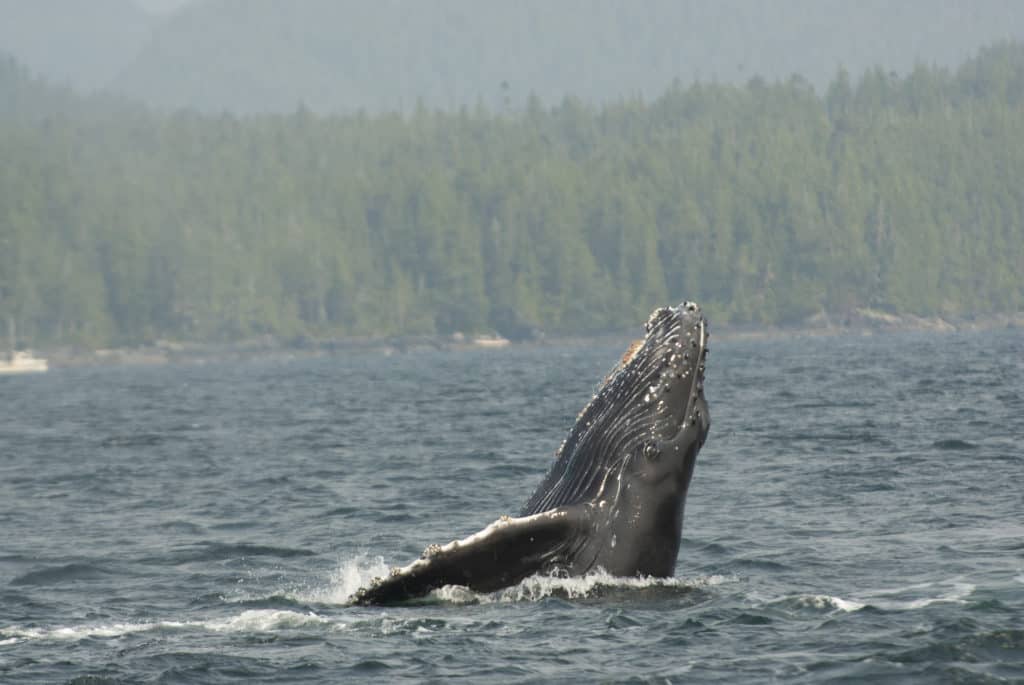
<p>Two of the most commonly spotted migratory whales in B.C. are the <a title="Humpback Whale (Megaptera novaeangliae)" href="http://wildwhales.org/humpback-whale/">humpback</a> and the <a title="Grey Whale (Eschrichtius robustus)" href="http://wildwhales.org/grey-whale/">grey whale</a>.  Both species, like most migratory cetaceans, spend their winters in equatorial areas and then summer in temperate or polar waters.  When migratory whales arrive in colder waters, they get straight down to business: eating. Like birds, whales travel in search of food.  While the azure waters of the tropics may look enticing, they do not contain nearly enough food to sustain large whales.  Instead, it is the cold, nutrient rich waters of the North Pacific that contain adequate sustenance needed for these whales to survive.  Diets of migratory baleen whales include krill, amphipods, and small schooling fish like herring, pilchards, and sandlance.  Because the whales are feeding very little or not at all while in warmer waters, it is paramount that they consume as much as possible when they can.   In fact, according to <a title="NOAA- Humpback whale" href="http://www.nmfs.noaa.gov/pr/species/mammals/cetaceans/humpbackwhale.htm">NOAA</a> (the American equivalent of DFO) a large adult humpback whale may gorge on up to 1,000 kg a day during the peak of summer feeding season!</p>
<p><strong><span style="text-decoration: underline;">Why migrate?</span></strong></p>
<p>While we welcome the greys and humpbacks back to B.C. each year, the question remains: why do they migrate?  Many other cetaceans are able to breed, give birth and have successful offspring in colder climates, so it’s unlikely that the long distance movements have much to do with ideal water temperature.  Furthermore, as established earlier, there is little to eat on those breeding grounds.  Perhaps the answer lies not in something they are seeking by travelling south, but in something they are escaping.</p>
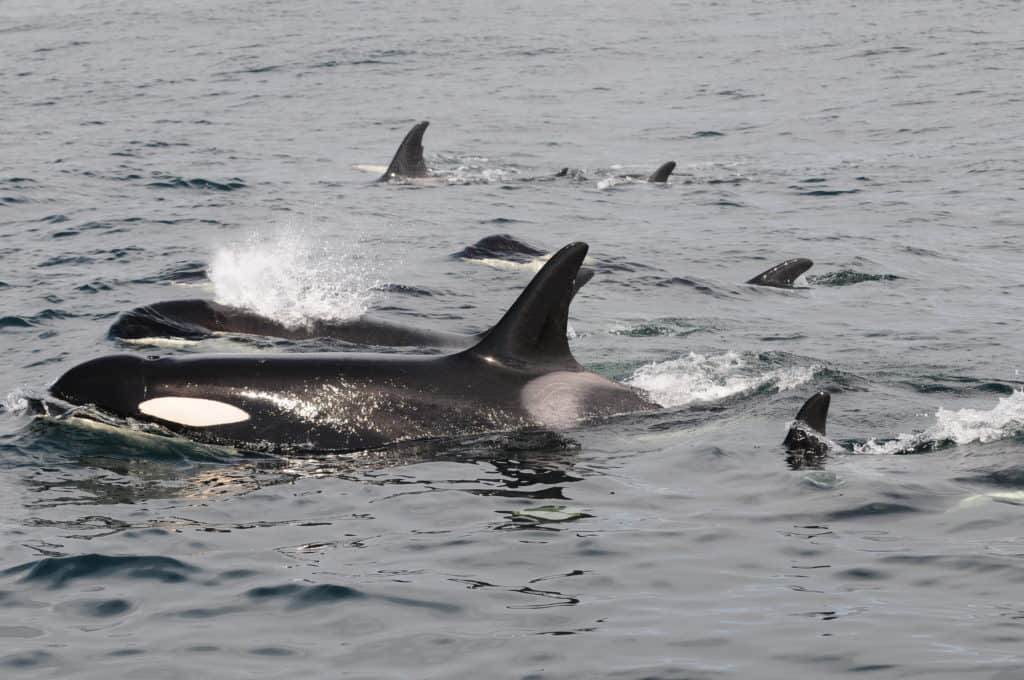
<p>While healthy adult humpback and grey whales likely have few natural predators, their calves are vulnerable to predation by <a title="Killer Whale (Orcinus orca)" href="http://wildwhales.org/killer-whale/">Bigg’s (transient) killer whales</a>.  Many whales bare tooth rake scars from killer whales on their flukes and flippers – evidence of narrow escapes.  It is possible that grey, humpback and other large whale species that migrate do so to give their young a head start in getting bigger, stronger and better able to avoid, evade or escape hungry Bigg’s killer whales once they head north.</p>
<p><strong><span style="text-decoration: underline;">Watching for wandering whales</span></strong></p>
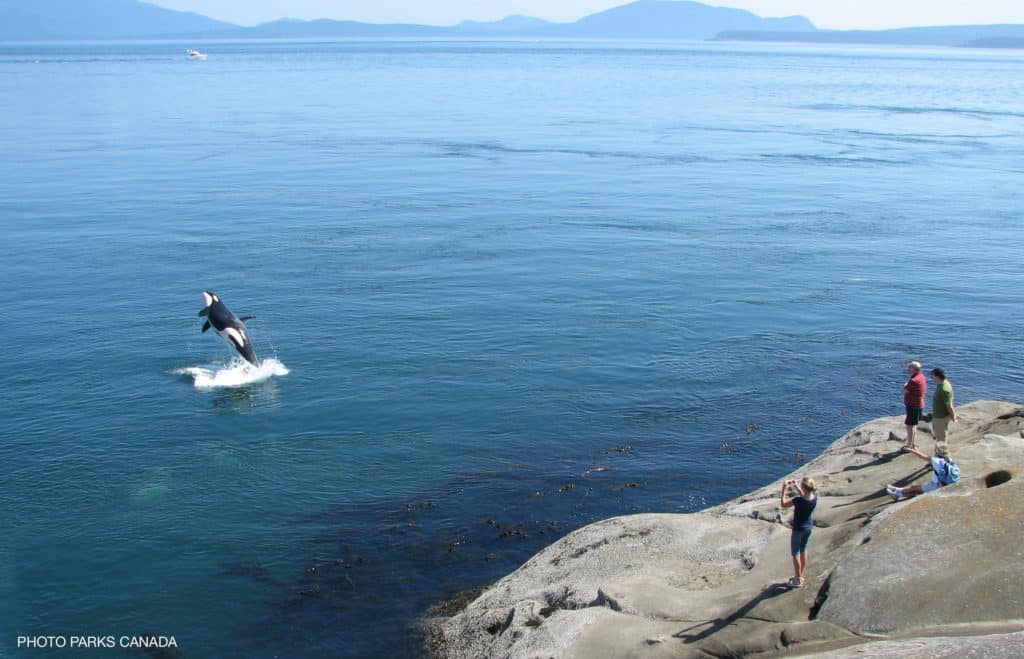
<p>Want to watch the migration?  Pacific Rim National Park is a great place to look for migrating grey whales in March- you can often seen them from headlands on shore!  <a title="Whalefest" href="http://www.pacificrimwhalefestival.com/" target="_blank">Whalefest </a>is held in the area each March as a celebration of the grey whale migration. Can’t make it to the West Coast?  Boundary Bay, just outside of Vancouver is an area that greys sometimes stop for a quick pit-stop.</p>
<p>Humpback whales can be found in many areas of the coast in the summer months.  By taking a whale watching trip from any of the major eco-tourism centres, you may find yourself face to face with one of these wandering whales.   Density of humpbacks tends to increase the further north on the coast you are.</p>
<p>Remember, if you see a wandering whale- report it!  Sightings of any whale, dolphin or porpoise should be reported to the BC Cetacean Sightings Network at <a href="http://www.wildwhales.org">www.wildwhales.org</a> or 1 866 I SAW ONE (472 9663).</p>
<p>&nbsp;</p>
]]></content:encoded>
			<wfw:commentRss>http://wildwhales.org/2013/02/wandering-whales/feed/</wfw:commentRss>
		<slash:comments>1</slash:comments>
		</item>
		<item>
		<title>Adventurers and Science!</title>
		<link>http://wildwhales.org/2013/02/adventure-and-science-matchmaking-for-conservation/</link>
		<comments>http://wildwhales.org/2013/02/adventure-and-science-matchmaking-for-conservation/#comments</comments>
		<pubDate>Wed, 06 Feb 2013 20:05:20 +0000</pubDate>
		<dc:creator>caitlin</dc:creator>
				<category><![CDATA[Conservation]]></category>

		<guid isPermaLink="false">http://wildwhales.org/?p=2547</guid>
		<description><![CDATA[Here at the BC Cetacean Sightings Network, we’re continually working to make connections with various categories of citizen scientists from along the coast. In 2013, we hope to add a new category to our observer list: adventure athlete. We’ve embarked on a new collaboration with Adventurers and Scientists for Conservation, an organization that plays matchmaker between outdoor enthusiasts willing to collect data and the scientific projects that need it.  <a href="<?p=2547 >Read More...</a>
]]></description>
				<content:encoded><![CDATA[<p>Sometimes we all need a little help finding the right match.  No, we’re not talking about dating sites and finding love, but here at the BC Cetacean Sightings Network, we’re continually working to make connections with various categories of citizen scientists from along the coast.  Our observers come from many walks of life: lighthouse keepers, whale watchers, ferry captains, beachcombers, fishermen, and pilots, to name a few.  They donate their time to recording and reporting their opportunistic sightings of whales, dolphins, porpoises and sea turtles.  In 2013, we hope to add a new category to our observer list: adventure athlete.</p>
<p>This year we’ve embarked on a new collaboration with <a href="http://www.adventureandscience.org">Adventurers and Scientists for Conservation</a>, an organization that plays matchmaker between outdoor enthusiasts willing to collect data and the scientific projects that need it.  Their aim is to provide opportunities for outdoor enthusiasts to make a difference as they play outdoors.  Since adventure athletes are often travelling into places that are remote, and time-consuming and expensive to reach, these partnerships provide researchers with information that is valuable and would be otherwise difficult to access.</p>
<p>By partnering with ASC, the Sightings Network is hoping to recruit rowers, paddlers, sailors and hikers venturing along the B.C. coast to collect and record their sightings of cetaceans and sea turtles (see our profile <a href="http://www.adventureandscience.org/whale-sightings.html">here</a>).  As expeditions often cover long distances, and venture into very remote areas of B.C.  (with little observer coverage otherwise), the sightings they collect will better the understanding of cetacean distribution and occurrence coast-wide.  Imagine an expedition paddling from Seattle to Ketchikan or circumnavigating Vancouver Island – there are athletes out there taking on these amazing feats and through ASC, we hope to harness some of their observations.  Don’t worry, we’ll provide waterproof data sheets and ID cards for that wet, west coast weather.</p>
<p>Could you be our adventure-athlete-turned-citizen-scientist match?  If you’re interested in getting involved with Adventurers and Scientists for Conservation, learn more <a href="http://www.adventureandscience.org/about-us.html">here</a>.</p>
]]></content:encoded>
			<wfw:commentRss>http://wildwhales.org/2013/02/adventure-and-science-matchmaking-for-conservation/feed/</wfw:commentRss>
		<slash:comments>0</slash:comments>
		</item>
		<item>
		<title>A killer debate</title>
		<link>http://wildwhales.org/2013/01/a-killer-debate-who-has-science-on-their-side/</link>
		<comments>http://wildwhales.org/2013/01/a-killer-debate-who-has-science-on-their-side/#comments</comments>
		<pubDate>Tue, 22 Jan 2013 00:59:32 +0000</pubDate>
		<dc:creator>caitlin</dc:creator>
				<category><![CDATA[Conservation]]></category>

		<guid isPermaLink="false">http://wildwhales.org/?p=2513</guid>
		<description><![CDATA[US conservation measures will be tested in 2013 with both sides claiming to have the scientific high-ground.]]></description>
				<content:encoded><![CDATA[<h5><span style="color: #000000;">Politics of killer whale conservation</span></h5>
<p><strong></strong>In November 2012, the US National Marine Fisheries Service served <a title="NMFS SRKW Public Notice" href="http://www.nwr.noaa.gov/Marine-Mammals/Whales-Dolphins-Porpoise/Killer-Whales/ESA-Status/delist.cfm" target="_blank">notice</a> that it had accepted a petition to delist southern resident killer whales under the US Endangered Species Act (ESA). The petition was filed by the Pacific Legal Foundation on behalf of the Center for Environmental Science Accuracy and Reliability, the Empresas Del Bosque company, and Coburn Ranch. At stake is the control of water formerly used to irrigate fields in California, which have been reverted to coastal rivers in efforts to restore salmon runs. Salmon is the critical prey resource for southern resident, or ‘fish-eating’, killer whales and protecting salmon was mandated to promote their recovery.</p>
<p>The <a title="SRKW Delist Petition 2012" href="http://www.nwr.noaa.gov/Marine-Mammals/Whales-Dolphins-Porpoise/Killer-Whales/ESA-Status/loader.cfm?csModule=security/getfile&amp;PageID=55249" target="_blank">petition</a> set in motion a formal review to re-evaluate all current scientific knowledge informing the legal status of the whales that ply the Salish Sea between Washington State and southern BC. Southern residents were listed as Endangered in 2005 based on ecological, behavioural, and genetic differences between themselves and other killer whales in the North Pacific. The petition asserts that new information on killer whale genetics calls into question the ‘uniqueness’ of southern residents and claims this is grounds for removing the ‘distinct population’ designation which affords the whales their current protection.<br />
<strong></strong></p>
<h5><span style="color: #000000;">Science vs. Science</span></h5>
<p><strong></strong>The petition cites a variety of studies but leans heavily on a 2010 publication in the <em>Journal of Evolutionary Biology</em> by Pilot and colleagues that suggests male killer whales may occasionally mate outside of their population (e.g. between different resident populations) or even between ecotypes (e.g. between ‘mammal-eating’ and ‘fish-eating’ killer whales). This information has been interpreted by the petitioners that killer whales should be considered a single species and therefore southern residents are not a distinct population. It should be noted that the study authors did not advocate for or against a single species designation. The central conclusion they drew from their data was that it emphasized the social cohesion of killer whales to produce genetic differences between populations despite the capacity for dispersal outside their groups. However, the petition used the results as a basis for their request to delist.<br />
In sharp contrast, a second publication in 2010 by Morin and colleagues in <em>Genome Research</em>, called for the elevation of certain populations of killer whales to full species and many others to the level of sub-species. Not surprisingly, this study received far less little attention in the petition yet both studies were peer reviewed and seem to present valid arguments. Which one is right?</p>
<p>Both studies looked at the genetic history of killer whales from populations around the globe but they did so with different goals and used different approaches. Therefore, comparing the studies is like comparing apples to oranges. The study authored by Pilot primarily looked at relationships between individual whales in the North Pacific. They used a combination of nuclear DNA (inherited from both parents) and mitochondrial DNA (inherited only from the mother) to trace the lineage of specific whales given their ecotype. Their data used a specific section of maternal DNA, the control loop, which is commonly used to delineate species through genetics. Computer programs assigned whales to populations and best estimates for the splits between ecotypes remained at 20,000 – 40,000 years ago.</p>
<p>The study by Morin primarily looked at population level relationships between killer whales instead of individual histories and had a much larger sample size. A new high-capacity genetic technique used the entire maternal DNA genome, instead of just the control loop, and a greater number of nuclear DNA sections were analyzed as well. The additional information revealed that Bigg’s (transient) killer whale ecotypes diverged much earlier than previously thought (~700,000 years ago) followed by further splits between other ecotypes as recent as ~150,000 years ago. They suggested placing Bigg’s killer whales as full species and other North Pacific killer whale ecotypes as separate sub-species pending more nuclear DNA work.</p>
<h5><span style="color: #000000;">Interpretation</span></h5>
<p><strong></strong>Central to the debate is the definition of a species which is no longer clear-cut. Genetics and evolutionary theory continue to change our understanding of how species differentiate. The biological species concept is changing from the static view that a species is a finite product to one where a species is considered to be in a dynamic, continually evolving state. This is challenging to interpret in the legal world where specific lines need to be drawn.</p>
<p>By initiating a review of the status of southern resident killer whales, the petition has forced administrators and lawyers to juggle evolving scientific concepts with seemingly opposing ‘evidence’ from recent genetics studies. It will be their interpretations of what defines a species and which genetic data best represent southern residents that will ultimately determine whether they continue to be protected under Endangered Species Act legislation in the United States.</p>
]]></content:encoded>
			<wfw:commentRss>http://wildwhales.org/2013/01/a-killer-debate-who-has-science-on-their-side/feed/</wfw:commentRss>
		<slash:comments>0</slash:comments>
		</item>
	</channel>
</rss>